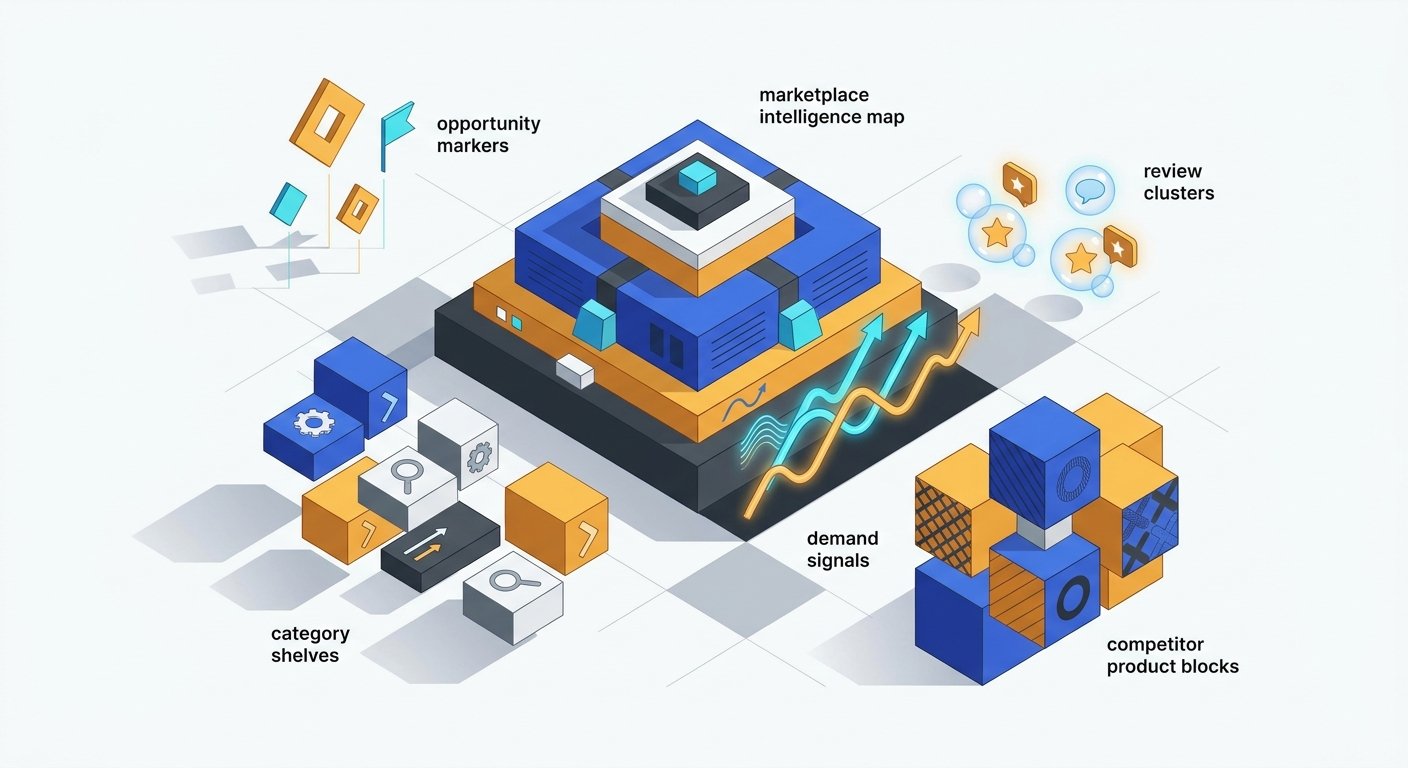
Amazon market intelligence is the ongoing practice of tracking marketplace signals so sellers can make better product, listing, pricing, inventory, and competitive decisions. It is broader than one product research project because it monitors how a category changes over time.
The best intelligence program combines hard signals, such as search behavior and competitor movement, with qualitative signals from buyer reviews. Numbers show what is changing. Customer language explains why it is changing and what a seller can do about it.
TL;DR: Amazon Market Intelligence: Seller Use Cases & Signals
| Signal area | What to monitor | How sellers use it |
|---|---|---|
| Demand | Niche activity, search behavior, seasonality, and shopper use cases. | Decide where to research, launch, or pause investment. |
| Competition | Price changes, listing updates, content quality, reviews, coupons, and positioning. | Spot threats and find openings before they become obvious. |
| Customer voice | Review themes, complaints, praise, questions, and buyer language. | Improve product requirements, listing copy, support, and differentiation. |
| Testing | Listing experiments, image changes, message tests, and post-launch learning. | Turn intelligence into measurable action instead of passive reporting. |
Definition and how it differs from product research
Amazon market intelligence is structured marketplace monitoring. Sellers collect and interpret data about demand, competitors, shoppers, reviews, pricing, listings, and category movement. The goal is to produce decisions, not a static report.
Product research usually supports one decision: whether to launch, improve, or reject a product idea. Market intelligence is continuous. It watches the category so sellers can notice changes before they show up as lost ranking, falling conversion, or rising ad cost.
The two practices should work together. Product research creates the initial decision. Market intelligence keeps that decision current as competitors, shopper language, and category expectations move.
The signals sellers should monitor
Start with demand and niche signals. Amazon's Product Opportunity Explorer is one official tool sellers can use to research demand, niches, and product opportunities. Pair those signals with competitor observation and review analysis so the team understands both what is happening and why.
Next, track listing and search signals. Titles, images, bullets, A+ content, keyword relevance, and conversion signals matter because Amazon shoppers rely on listing clarity before buying. Amazon's Amazon SEO guide is a useful official reference for improving product search visibility.
Finally, track testing signals. When eligible, Manage Your Experiments lets sellers test listing content. Market intelligence should feed those tests with hypotheses based on competitor movement and buyer language.
Use cases that turn intelligence into action
Market intelligence can spot a category shift early. Buyers may begin talking more about portability, refills, eco-friendly packaging, compatibility, or safety before those themes become obvious in titles. Monitoring buyer language helps sellers update product requirements and listing copy before the market fully catches up.
It also helps track competitor positioning. Competitors change images, coupons, bundles, variations, and feature claims. A new image angle may indicate a tested buyer objection. A bundle may signal that shoppers expect an accessory. A price cut may show margin pressure.
The most useful brief turns those observations into one recommended action. That action might be a product requirement, a listing test, a support update, a pricing review, or a decision to watch the signal for another cycle.
Dashboard and operating rhythm
A useful dashboard does not need dozens of widgets. It needs a small set of signals that connect to decisions. Sellers can start with demand, competitor, customer-voice, and execution signals, then expand only when a recurring question cannot be answered.
| Dashboard area | Signal to track | Decision it supports |
|---|---|---|
| Demand | Niche movement, search behavior, review volume, and seasonal changes. | Where to invest research, inventory, or content effort. |
| Competitors | Price, coupon, image, title, bundle, and review changes on priority ASINs. | Whether to respond, ignore, or test a counter-position. |
| Customer voice | Repeated complaints, praised features, questions, and emerging use cases. | Which product or listing improvement should move first. |
| Execution | Experiment results, conversion movement, support issues, and post-launch reviews. | Whether the chosen action improved market position. |
For active categories, use a lightweight operating rhythm: weekly competitor checks, monthly review-theme summaries, and quarterly strategy reviews. This prevents sellers from overreacting to noise while still catching material shifts early.
Where VOC AI fits into market intelligence
VOC AI helps convert large volumes of review text into themes, sentiment, pain points, and buyer language. That makes it useful for ongoing market intelligence because sellers can monitor what customers are saying across competing products, not just what their own dashboard shows.
The same insight can serve multiple teams. Product teams use it to prioritize feature changes. Listing teams use it to improve images and bullets. Advertising teams use it to align campaigns with buyer language. Support teams use it to anticipate objections. Leadership uses it to decide whether a category deserves more budget or a slower approach.

Common mistakes and immediate attention signals. The first mistake is reporting data without a decision. The second is watching competitors but ignoring customers. The third is refreshing intelligence only after sales fall. Sellers should also avoid overreacting to one competitor move or one unusual review. Look for repeated patterns across time and across listings.
Some signals deserve immediate review: repeated new complaints about safety, compatibility, packaging, or durability; sudden competitor price drops; a competitor adding a bundle or new variation; or a sharp increase in buyer questions. Immediate attention does not always mean immediate change. It means the seller should inspect the evidence and assign a test or monitoring owner.
Good intelligence is specific, current, and tied to action. It does not say reviews are important. It says buyers repeatedly mention a certain problem on multiple competing ASINs, and the next listing or product test should address that blocker.
FAQ
What is Amazon market intelligence? It is the ongoing process of monitoring demand, competition, reviews, pricing, search behavior, and listing changes across Amazon categories so sellers can identify opportunities, threats, and tests.
How is it different from product research? Product research supports one product or launch decision. Market intelligence is continuous and category-wide, helping sellers track changes after the initial decision.
What signals should sellers monitor? Sellers should monitor demand, competitor listings, price changes, review themes, buyer questions, search relevance, coupons, bundles, and experiment results.


